You had plans for that patio: a table, some chairs, maybe a string of lights and a cold drink once the evenings got longer. But five solid months of rain have turned your grand outdoor vision into something that looks more like a disused canal towpath.
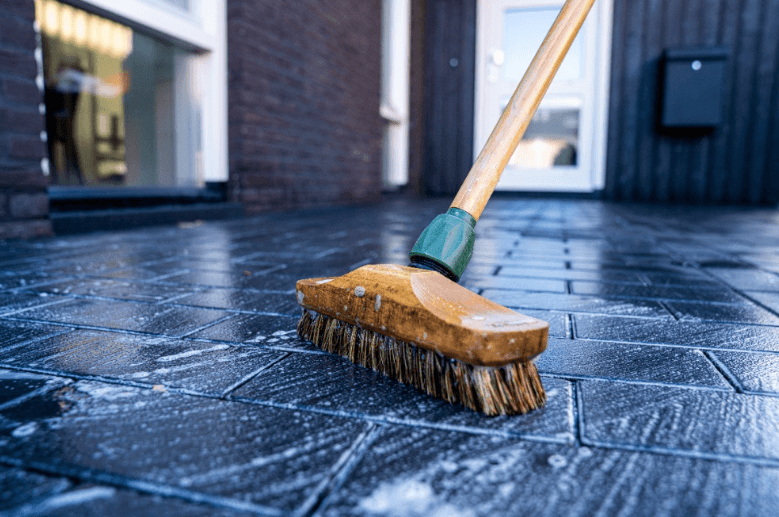
There’s a greenish film across every slab. The grouting has gone dark in places you didn’t know grouting existed, and the corner near the drainpipe has developed a texture you’d rather not investigate without shoes, gloves, and a mask.
That is what a British winter does to outdoor stone, and right now, patios across the country are in exactly the same condition. Here’s exactly why this occurs.
Wet Winters Leave Far Worse Damage Than a Normal Season
A typical British winter is damp enough. But the last few years have delivered relentless, prolonged wet spells that keep paving soaked for months without a proper chance to dry out.
That sustained moisture feeds algae and moss growth on a completely different scale to what you’d see after a mild winter. Instead of a few green patches in the shady corner, you end up with a thick, established layer covering the entire surface.
The longer the wet weather lasts, the deeper the grime bonds to the stone. By the time spring arrives, you’re not dealing with a bit of seasonal grubbiness; you’re looking at months of accumulated buildup that has physically bonded to the paving.
That level of embedded grime is what’s sending homeowners straight past the bucket-and-brush stage and into professional territory.
Frost Cycles Crack Mortar and Loosen Slabs
Rain alone would be bad enough, but freezing temperatures cause genuine freeze-thaw damage.
This happens when water seeps into the porous surface of paving slabs and settles into the mortar joints. When the temperature drops below zero, that water expands. And when it thaws, it contracts.
Each freeze-thaw cycle widens the cracks a fraction further, and over a full winter, the cumulative effect is brutal.
You’ll start noticing crumbled mortar between the joints, slabs that have shifted slightly out of alignment, and hairline fractures across surfaces that looked perfectly solid six months ago.
This kind of damage makes homeowners realise that their patio needs professional attention before the cracks get worse and the repair bill starts climbing. Catching it early with a proper clean and inspection is far cheaper than relaying an entire section of paving in the summer.
Algae Buildup Creates a Genuine Slip Hazard
A patio that looks a bit grim is one thing, but a patio that could put someone in A&E tends to move up the priority list very fast. And in the UK, where a surprise shower can roll in on even the sunniest afternoon, you’ll face that hazard for most of the year.
Carrying a tray of drinks outside in flip-flops is the kind of decision that ends with you flat on your back, questioning your life choices while the dog licks tea off your face.
But beyond the comedy, slips on outdoor surfaces are a genuinely common cause of household injuries, particularly among older family members.
That safety angle is a major reason why demand for professional cleaning spikes every spring. You can live with a patio that looks rough, but a patio that could put someone in A&E tends to move up the priority list very fast.
You Won’t Fix This Level of Grime With a Brush and Bucket
You can absolutely tackle mild surface algae yourself. A stiff-bristled brush and warm soapy water will shift a light seasonal coating without much trouble. But after a prolonged wet winter, the buildup goes well beyond what household tools can reach.
Boiling water kills moss on contact, which is deeply satisfying, but it won’t destroy the root system already embedded in the mortar.
The moss will be back within weeks, and you’ll find yourself out there with the kettle again like a very committed but increasingly weary groundskeeper.
Pressure washers are tempting, but too much force on sandstone will strip the surface layer, widen the mortar joints, and leave the area looking worse than it did before you started.
You could also drive water deep into the masonry, which will cause damp problems that show up on your interior walls weeks later. Once homeowners hit this wall with DIY, professional cleaning becomes the obvious next step.
See also: Empty Homes Reveal Surprising Hidden Dirt After Moving
Cleaning Costs a Fraction of Replacing Damaged Paving
A full patio relay—lifting, re-laying, and repointing—can run into thousands of pounds depending on the size and material. However, a professional clean on the same space is a fraction of that cost.
When you factor in the price of new slabs, sand, cement, and labour, the maths stops being close. Cleaning a patio that still has structural life in it is one of the most straightforward ways to protect that investment without you having to spend a fortune.
If your outdoor surfaces have had a battering over the past few months, booking a driveway and patio cleaning service will save you a full weekend of effort. They’ll also deliver results you won’t replicate with a garden hose.
The slabs are usually still perfectly good underneath the grime; they just need someone with the right equipment to prove it.
More People Are Using Their Outdoor Spaces
The other side of the boom is simply that people are more concerned about their patios than they used to. Since the pandemic, outdoor spaces across the UK have gone from afterthought to an extension of their living room.
Homeowners are investing in furniture, lighting, and outdoor kitchens, and a filthy patio undermines all of it.
You wouldn’t lay a new rug on a dirty floor, and the same logic applies outside. If you’ve spent money making the space look good, the surface underneath needs to match.
This shift in how people use their gardens has turned patio cleaning from a once-in-a-blue-moon chore into a regular seasonal task.
And when the winter has been particularly harsh, the gap between what you want the patio to look like and what it actually looks like becomes impossible to ignore.
Conclusion
Now you know exactly why every patio in Britain looks like it’s been through a rough patch, and more importantly, what to do about it.
So get the cleaning sorted before the first warm weekend catches you apologising to guests for the state of the slabs.
Once it’s done, dust off the barbecue, drag the chairs out, and finally crack open that cold one you’ve been saving since the clocks went back. Your patio owes you a good summer!