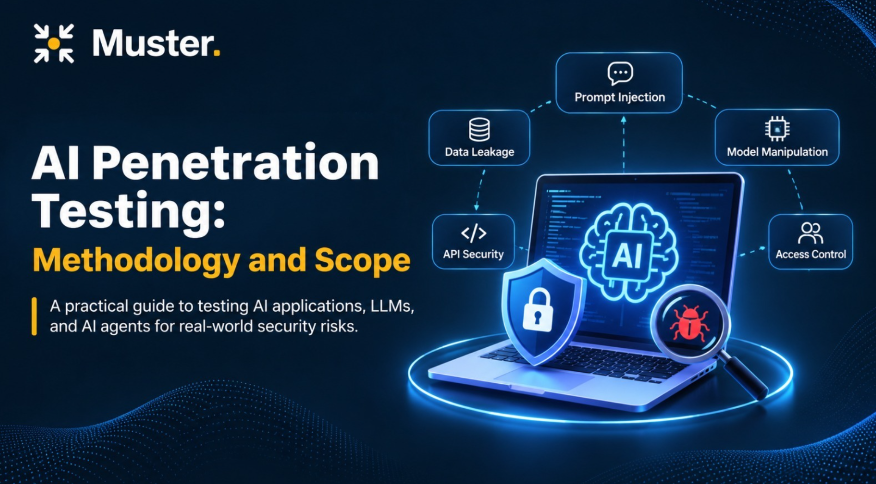
Artificial intelligence is transforming how businesses build applications, automate workflows, process information, and interact with customers. From AI-powered chatbots and Large Language Models (LLMs) to autonomous AI agents and machine learning platforms, organizations are increasingly integrating intelligent systems into their business operations.
However, these advancements introduce security risks that traditional penetration testing approaches may not fully address. AI applications can be vulnerable to prompt injection, sensitive information disclosure, data poisoning, model manipulation, insecure integrations, and unauthorized access to connected systems.
AI penetration testing is a specialized security assessment designed to identify and validate vulnerabilities across AI models, applications, APIs, data pipelines, and connected infrastructure. It evaluates how an AI system behaves under adversarial conditions and whether attackers can manipulate its responses, access restricted information, or trigger unauthorized actions.
At Muster Security, understanding the methodology and scope of AI penetration testing is essential for organizations looking to secure their AI-powered environments, reduce emerging threats, and maintain confidence in their technology.
This guide explains how AI penetration testing works, what it covers, which vulnerabilities security teams should prioritize, and how organizations can implement an effective testing strategy.
What Is AI Penetration Testing?
AI penetration testing is a security assessment that evaluates artificial intelligence systems for exploitable vulnerabilities. It involves simulating real-world attacks against AI applications, machine learning models, LLM-powered platforms, and their supporting infrastructure.
Unlike conventional penetration testing, which primarily examines application logic, networks, endpoints, and infrastructure, AI penetration testing also evaluates model behavior, prompt handling, training data exposure, retrieval mechanisms, and interactions with external tools.
The objective is to determine whether an attacker can:
- Manipulate an AI model through malicious prompts.
- Extract confidential information from model responses.
- Bypass system instructions and security restrictions.
- Access another user’s information through AI-powered features.
- Poison training or retrieval datasets.
- Exploit connected APIs and external integrations.
- Manipulate autonomous AI agents into performing unauthorized actions.
- Abuse weaknesses in authentication and authorization mechanisms.
For example, an organization may deploy an AI customer support chatbot connected to its internal knowledge base. If the application does not properly enforce access permissions, an attacker might manipulate the chatbot into retrieving confidential documents or information belonging to another customer.
AI penetration testing helps identify these weaknesses before they can be exploited in production environments.
Why Is AI Penetration Testing Important?
AI applications introduce attack surfaces that may not exist in traditional software systems. Their behavior depends on models, prompts, external data, user inputs, and integrations, creating security challenges across multiple layers.
Organizations should consider AI penetration testing for several reasons.
1. Prevent Prompt Injection Attacks
Prompt injection occurs when attackers manipulate an AI model through carefully crafted instructions. These instructions may attempt to override system prompts, bypass restrictions, or influence how the model processes information.
Indirect prompt injection can also occur through external content, including uploaded documents, websites, emails, and retrieved knowledge sources.
Security testing evaluates whether malicious instructions can influence model behavior or expose restricted information.
2. Protect Sensitive Business Information
AI systems frequently process customer information, internal documents, business records, and confidential communications.
Weak access controls, insecure retrieval mechanisms, and improper data handling can expose sensitive information through model responses.
Penetration testing assesses whether users can retrieve information outside their authorized permissions.
3. Secure AI Integrations and APIs
Many AI applications connect to third-party APIs, cloud services, databases, and internal business applications.
An improperly secured integration may allow attackers to manipulate API requests, access protected resources, or trigger unauthorized operations.
Testing validates authentication, authorization, API permissions, and secure communication between integrated components.
4. Reduce AI Model Manipulation Risks
Attackers may attempt to manipulate model behavior through adversarial inputs, malicious training data, or compromised retrieval sources.
Testing helps identify weaknesses in data validation, model deployment, and the processes used to maintain AI systems.
5. Maintain Customer Trust and Compliance Readiness
AI applications that expose confidential information or perform unauthorized actions can damage customer relationships and organizational reputation.
Regular security assessments help organizations demonstrate responsible security practices and support broader risk management and compliance initiatives.
AI Penetration Testing Methodology
An effective AI penetration testing methodology combines conventional application security techniques with specialized AI security testing.
At Muster Security, a structured assessment approach should consider the complete AI application lifecycle, from initial reconnaissance to exploitation validation and remediation.
1. Scoping and Assessment Planning
The first stage defines the testing objectives, boundaries, and technical components included in the engagement.
Security professionals work with stakeholders to understand the AI architecture, deployment environment, integrations, and potential business risks.
The scope may include:
- AI-powered web applications and chatbots.
- Large Language Models and machine learning models.
- Model hosting and inference endpoints.
- Prompt templates and system instructions.
- Retrieval-Augmented Generation (RAG) pipelines.
- Vector databases and embedding services.
- APIs and third-party integrations.
- AI agent workflows and tool-calling capabilities.
- Authentication and authorization mechanisms.
- Training and retrieval data sources.
A clearly defined scope ensures that testing focuses on realistic attack scenarios without disrupting production operations.
2. AI Application Reconnaissance
Reconnaissance involves understanding the target AI application’s architecture and identifying potential entry points.
Testers examine publicly accessible interfaces, API endpoints, authentication workflows, model integrations, and available functionality.
Typical activities include:
- Identifying AI model providers and exposed endpoints.
- Reviewing application architecture and data flows.
- Mapping API integrations.
- Identifying input and output processing mechanisms.
- Examining user roles and access permissions.
- Reviewing exposed configuration and metadata.
- Identifying connected databases and external services.
This phase helps establish the application’s attack surface and identify areas requiring deeper security testing.
3. Prompt Injection and Instruction Manipulation Testing
Prompt injection is one of the most important attack categories in LLM application security.
Testers submit adversarial prompts designed to manipulate model behavior, override instructions, and access information that should remain restricted.
Testing scenarios may include:
- Direct prompt injection.
- Indirect prompt injection through external content.
- System prompt extraction attempts.
- Instruction hierarchy manipulation.
- Role-based restriction bypass.
- Malicious document and file uploads.
- Context manipulation.
- Multi-turn conversational attacks.
The assessment determines whether the application can distinguish trusted instructions from untrusted user-provided or retrieved content.
4. Sensitive Information Disclosure Testing
AI systems may unintentionally disclose information through model responses, retrieval mechanisms, application logs, or improperly configured integrations.
Testers evaluate whether unauthorized users can obtain confidential information.
The assessment may cover:
- System prompt disclosure.
- Exposure of API keys and credentials.
- Cross-user conversation data leakage.
- Retrieval of restricted documents.
- Sensitive information in model outputs.
- Improper session isolation.
- Training and inference data exposure.
- Confidential business information disclosure.
For RAG-based applications, testers also examine whether retrieval permissions are correctly enforced before documents are supplied to the model.
5. AI Model and Data Security Testing
Machine learning systems depend on training datasets, inference inputs, model configurations, and data processing pipelines.
Weaknesses in these components can affect model reliability, confidentiality, and integrity.
Testing may investigate:
- Data poisoning risks.
- Adversarial input manipulation.
- Model extraction exposure.
- Model inversion risks.
- Insecure model serialization.
- Training data leakage.
- Model endpoint access controls.
- Unauthorized model modification.
The testing approach depends on the model architecture, available access, and engagement objectives.
6. API and Tool-Calling Security Assessment
Modern AI applications frequently use function calling and external tools to perform tasks such as retrieving records, sending emails, updating databases, and executing workflows.
These capabilities can significantly increase the impact of an AI vulnerability.
Testers examine whether attackers can manipulate AI-generated actions or abuse the permissions assigned to connected tools.
Common assessment areas include:
- API authentication and authorization.
- Excessive permissions.
- Broken Object Level Authorization (BOLA).
- Broken Function Level Authorization (BFLA).
- Unauthorized database operations.
- Insecure tool execution.
- Parameter manipulation.
- Server-side request forgery (SSRF) risks.
- Improper validation of AI-generated requests.
The objective is to determine whether an attacker can turn an AI interaction into an unauthorized operation against connected systems.
7. Business Logic and Multi-Step Attack Testing
Some AI vulnerabilities cannot be identified through individual prompts or automated scanning.
Attackers may combine multiple weaknesses to achieve a larger security impact.
For example, an attacker might exploit a prompt injection vulnerability to influence an AI agent, manipulate its tool selection, and access a resource through an overly privileged API integration.
Testers evaluate these multi-step scenarios to understand how vulnerabilities interact across the application.
8. Reporting and Remediation Validation
After testing is complete, security professionals document validated vulnerabilities and explain their potential business impact.
A comprehensive AI penetration testing report typically includes:
- Executive summary.
- Testing scope and methodology.
- Identified vulnerabilities.
- Severity and risk classification.
- Technical evidence and proof of concept.
- Exploitation scenarios.
- Business impact analysis.
- Recommended remediation steps.
- Retesting results.
After remediation, retesting helps confirm whether the identified vulnerabilities have been properly addressed.
AI Penetration Testing Scope: What Should Be Included?
Defining the scope is one of the most important parts of an AI security assessment. AI applications often depend on several interconnected components, and testing only the model may leave significant security gaps.
The following table outlines the major components organizations should consider.
| Testing Area | Assessment Focus |
| AI Models and LLMs | Model behavior, manipulation, extraction, and information exposure |
| Prompt Security | Prompt injection, instruction bypass, and system prompt disclosure |
| APIs | Authentication, authorization, and endpoint security |
| RAG Architecture | Document retrieval, embedding security, and access isolation |
| Vector Databases | Data access, tenant separation, and information exposure |
| AI Agents | Tool permissions, autonomous actions, and workflow manipulation |
| Training Data | Data poisoning, integrity, and confidentiality |
| Cloud Infrastructure | Configuration, secrets, storage, and access controls |
| User Authentication | Session security, identity verification, and role enforcement |
| Third-Party Integrations | External API permissions and integration security |
Standalone AI Applications
Standalone AI applications are systems where users interact directly with an AI model through an interface or API.
Testing should evaluate input validation, model access, prompt security, output handling, authentication, and information disclosure.
AI-Integrated Web Applications
Many traditional web applications now include AI-powered features.
For these systems, testing must cover both the AI functionality and the underlying web application.
This includes conventional vulnerabilities such as:
- SQL injection.
- Cross-Site Scripting (XSS).
- Broken access control.
- Insecure authentication.
- Session management weaknesses.
- Server-Side Request Forgery (SSRF).
- API security vulnerabilities.
Retrieval-Augmented Generation Applications
RAG applications retrieve information from external knowledge sources before generating responses.
Their security depends on the model, retrieval pipeline, vector database, document permissions, and data processing mechanisms.
Testing should verify that users cannot retrieve unauthorized documents or manipulate the retrieval process using malicious content.
Agentic AI Systems
AI agents can interact with external tools, APIs, databases, and business applications.
Their increased autonomy introduces additional risks related to permissions, action validation, and execution boundaries.
Testing should assess whether an agent can be manipulated into performing actions beyond its intended authority.
Common AI Security Vulnerabilities
Understanding common AI security vulnerabilities helps organizations prioritize their testing activities.
Some important vulnerability categories include:
Prompt Injection
Attackers manipulate model instructions through direct or indirect prompts to bypass intended restrictions or influence responses.
Sensitive Information Disclosure
An AI application exposes confidential information through responses, retrieved documents, conversation history, or insecure integrations.
Training Data Poisoning
Malicious or manipulated data introduced into a training or fine-tuning pipeline can influence model behavior and reduce its integrity.
Model Inversion
Attackers attempt to infer sensitive information about the data used to train a model through model outputs.
Model Extraction
An attacker attempts to reproduce a model or infer its functionality by repeatedly querying an exposed model endpoint.
Excessive Agency
An AI application has more permissions or operational capabilities than necessary, allowing manipulated model outputs to trigger unauthorized actions.
Insecure Output Handling
Applications use AI-generated content without appropriate validation or sanitization, potentially creating downstream security vulnerabilities.
Improper Access Control
AI applications fail to enforce permissions consistently across users, sessions, documents, tools, and connected resources.
AI Penetration Testing vs. Traditional Penetration Testing
Traditional penetration testing and AI penetration testing share several security assessment techniques. However, they differ in the systems and attack scenarios they prioritize.
| Comparison | Traditional Penetration Testing | AI Penetration Testing |
| Primary Focus | Applications, networks, APIs, and infrastructure | AI models, prompts, agents, data, and integrations |
| Input Testing | Forms, parameters, and requests | Natural language, prompts, documents, and adversarial inputs |
| Common Attacks | SQL injection, XSS, authentication bypass | Prompt injection, data poisoning, model manipulation |
| Data Security | Database and application data exposure | Training data, retrieval data, and model output leakage |
| Access Control | User roles and application permissions | User permissions, model context, and tool permissions |
| Testing Methods | Manual testing and automated scanners | AI-specific testing, adversarial techniques, and manual validation |
| Business Impact | Unauthorized access and system compromise | Data leakage, manipulated decisions, and unauthorized AI actions |
Organizations deploying AI-powered features should not consider AI penetration testing a replacement for traditional security assessments. Both approaches are necessary for evaluating the complete application environment.
AI Penetration Testing Tools and Frameworks
Security professionals can use specialized tools and frameworks to improve AI security testing coverage.
Some useful resources include:
1. OWASP Top 10 for LLM Applications
The OWASP Top 10 for LLM Applications provides a structured overview of important security risks affecting LLM-powered applications. It helps testers identify areas such as prompt injection, sensitive information disclosure, excessive agency, and insecure output handling.
2. MITRE ATLAS
MITRE ATLAS is a knowledge base of adversary tactics and techniques targeting artificial intelligence systems. It helps security teams understand how attackers may compromise or manipulate machine learning environments.
3. Garak
Garak is an LLM vulnerability scanner designed to probe language models for potential security weaknesses and undesirable behaviors.
4. PyRIT
Microsoft’s Python Risk Identification Toolkit (PyRIT) supports automated red teaming of generative AI systems by helping security professionals assess potential risks through adversarial testing.
5. Promptfoo
Promptfoo supports testing and evaluation of LLM applications, including security-focused assessments of prompts, model outputs, and application behavior.
These tools can support repeatable assessments, but automated results should always be validated against the application’s actual architecture and business context.
Best Practices for Securing AI Applications
Organizations should integrate AI security into their development and deployment processes rather than treating it as a one-time activity.
Consider the following practices:
- Apply least-privilege permissions: Restrict AI models and agents to only the resources and operations they require.
- Validate user inputs: Implement appropriate controls for prompts, uploaded documents, and external content.
- Protect sensitive information: Prevent unauthorized access to confidential records, credentials, and internal documents.
- Secure API integrations: Enforce authentication, authorization, rate limiting, and request validation.
- Isolate user sessions: Ensure conversation histories and retrieved information remain separated between users.
- Validate AI-generated actions: Require appropriate authorization and validation before executing sensitive operations.
- Monitor AI activity: Log relevant security events and investigate unusual behavior.
- Test after major changes: Reassess security following model updates, prompt modifications, and new integrations.
- Conduct regular penetration testing: Schedule security assessments based on system risk and development frequency.
Combining these practices with continuous monitoring and independent security assessments can help organizations maintain a stronger AI security posture.
How Often Should Organizations Conduct AI Penetration Testing?
AI systems evolve rapidly. Changes to models, prompts, datasets, APIs, and third-party integrations can introduce new vulnerabilities.
The appropriate testing frequency depends on the application’s risk profile, sensitivity of information, and rate of change.
A practical testing strategy may include:
- Before deployment: Assess new AI applications before they become publicly accessible.
- After major updates: Test significant model changes, new integrations, and additional agent capabilities.
- Quarterly or semi-annually: Conduct periodic assessments for systems with ongoing security exposure.
- After security incidents: Perform targeted testing to identify related vulnerabilities and prevent recurrence.
- During development: Integrate automated security checks into CI/CD workflows.
High-risk AI applications handling financial, healthcare, or other sensitive information may require more frequent and targeted assessments.
AI Penetration Testing and Security Compliance
AI penetration testing can support an organization’s broader security governance and risk management activities.
Relevant frameworks and standards include:
- ISO/IEC 42001: Provides requirements for establishing and maintaining an Artificial Intelligence Management System.
- OWASP Top 10 for LLM Applications: Helps identify security risks specific to LLM-powered applications.
- MITRE ATLAS: Provides a structured knowledge base of adversarial techniques targeting AI systems.
- NIST AI Risk Management Framework: Provides guidance for managing risks associated with AI systems throughout their lifecycle.
These resources serve different purposes. A penetration test provides technical evidence of security weaknesses, while governance frameworks help organizations establish broader processes for identifying, managing, and monitoring AI-related risks.
See also: How to Budget for a New Lawn in Hervey Bay
Conclusion
As artificial intelligence becomes increasingly integrated into business applications, securing AI systems requires more than conventional vulnerability scanning. Organizations must understand how models process instructions, retrieve information, interact with external services, and execute actions.
AI penetration testing provides a structured approach to identifying vulnerabilities across AI models, LLM applications, APIs, data sources, and connected infrastructure. By combining adversarial testing, traditional application security techniques, and human-led validation, organizations can better understand their exposure to emerging AI threats.
Muster Security helps organizations strengthen their security posture through practical security assessment approaches that focus on identifying vulnerabilities, validating real-world risks, and supporting effective remediation.
Whether you are deploying an AI chatbot, integrating an LLM into an existing application, or building autonomous AI agents, proactive security testing is an important step toward protecting your systems, data, and users.
Ready to assess the security of your AI applications? Contact Muster Security to discuss your AI penetration testing requirements and build a stronger security strategy.
Frequently Asked Questions About AI Penetration Testing
1. What is AI penetration testing?
AI penetration testing is the process of assessing artificial intelligence applications, models, and supporting infrastructure for security vulnerabilities. It identifies risks such as prompt injection, data leakage, model manipulation, insecure APIs, and unauthorized access.
2. Why is AI penetration testing necessary?
AI penetration testing helps organizations identify security weaknesses that may expose confidential information, compromise AI model behavior, or allow attackers to manipulate automated workflows. It supports proactive risk reduction and helps protect business operations.
3. What does an AI penetration test cover?
An AI penetration test may cover LLM applications, AI models, prompt security, RAG pipelines, vector databases, APIs, AI agents, authentication, authorization, cloud infrastructure, and third-party integrations.
4. What are the most common AI security vulnerabilities?
Common vulnerabilities include prompt injection, sensitive information disclosure, data poisoning, model inversion, model extraction, insecure output handling, excessive agency, and improper access control.
5. How does prompt injection affect AI applications?
Prompt injection manipulates an AI model through malicious instructions. Depending on the application’s architecture and security controls, attackers may bypass restrictions, influence responses, expose sensitive information, or manipulate connected tools.
6. Can AI penetration testing identify data leakage?
Yes. Testing can identify weaknesses that allow unauthorized users to access confidential information through model responses, conversation histories, retrieval systems, APIs, and connected databases.
7. Do AI penetration testing tools replace manual testing?
No. Automated tools help identify potential weaknesses and improve testing coverage, but experienced security professionals are essential for validating vulnerabilities, assessing business logic, and investigating complex multi-step attack scenarios.
8. What is the difference between AI red teaming and AI penetration testing?
AI red teaming generally focuses on adversarial scenarios designed to evaluate the security, safety, and robustness of AI systems. AI penetration testing focuses more specifically on identifying and validating exploitable security vulnerabilities across the AI application and its infrastructure. Their methodologies can overlap.
9. How long does AI penetration testing take?
The duration depends on the application’s complexity, number of integrations, testing scope, and access provided. A focused assessment may take several days, while larger enterprise AI environments may require multiple weeks.
10. How often should AI applications be penetration tested?
Organizations should conduct assessments before major deployments, after significant architectural or model changes, and periodically throughout the year. Quarterly or semi-annual testing may be suitable for many environments, depending on risk.
11. What frameworks are used for AI penetration testing?
Commonly referenced resources include the OWASP Top 10 for LLM Applications, MITRE ATLAS, and the NIST AI Risk Management Framework. These resources help guide security assessments and AI risk management.
12. Can AI agents be included in penetration testing?
Yes. AI agent assessments can evaluate tool permissions, API integrations, autonomous actions, access controls, workflow manipulation, and the potential consequences of malicious instructions.
13. Is AI penetration testing different from LLM penetration testing?
AI penetration testing covers a broad range of artificial intelligence technologies, including machine learning systems, LLMs, and AI agents. LLM penetration testing focuses specifically on applications and systems powered by large language models.
14. What should an AI penetration testing report include?
A report should include the assessment scope, methodology, identified vulnerabilities, severity ratings, technical evidence, potential business impact, remediation recommendations, and retesting results.
15. Can AI penetration testing help with ISO 42001 readiness?
Yes. Technical security assessment findings can support AI risk identification and treatment activities associated with ISO/IEC 42001. However, penetration testing alone does not establish compliance or certification.